
Reach Clinicians Directly
List products with full sourcing and regulatory context, and reach verified clinicians directly, without losing visibility into where products end up.

Independent practices deserve to know exactly what they're buying, who they're buying it from, and whether it's appropriate for their license and their state. MedGrid is the marketplace built to make all three the default — not the exception.
We'd rather publish the real numbers than impressive ones. These come straight from the marketplace.
MedGrid is built by Skydell Holdings, a company that has spent years supplying independent physicians the old way — phone calls, faxes, spreadsheets, and sales reps. That experience taught us where medical purchasing actually breaks: not at the loading dock, but at trust.
Clinicians can rarely verify a vendor's claims before ordering. Vendors can rarely verify that a buyer is a licensed clinician at all. And the rules that govern what may be sold, to whom, and where are scattered across dozens of regulators — so everyone quietly hopes someone else checked.
A marketplace where both sides are verified shouldn't be remarkable. In medicine, it still is.
So we built the marketplace we wished existed: manufacturers, distributors, and clinicians on one platform, with identity and credentials verified on both sides of every transaction, and the catalog gated by what each buyer is actually permitted to purchase.
Where we are today: MedGrid is live with 2,100+ products from 15 verified vendors, and we're onboarding more now. New vendors, categories, and features ship release by release. We'd rather tell you what's live than what's planned.
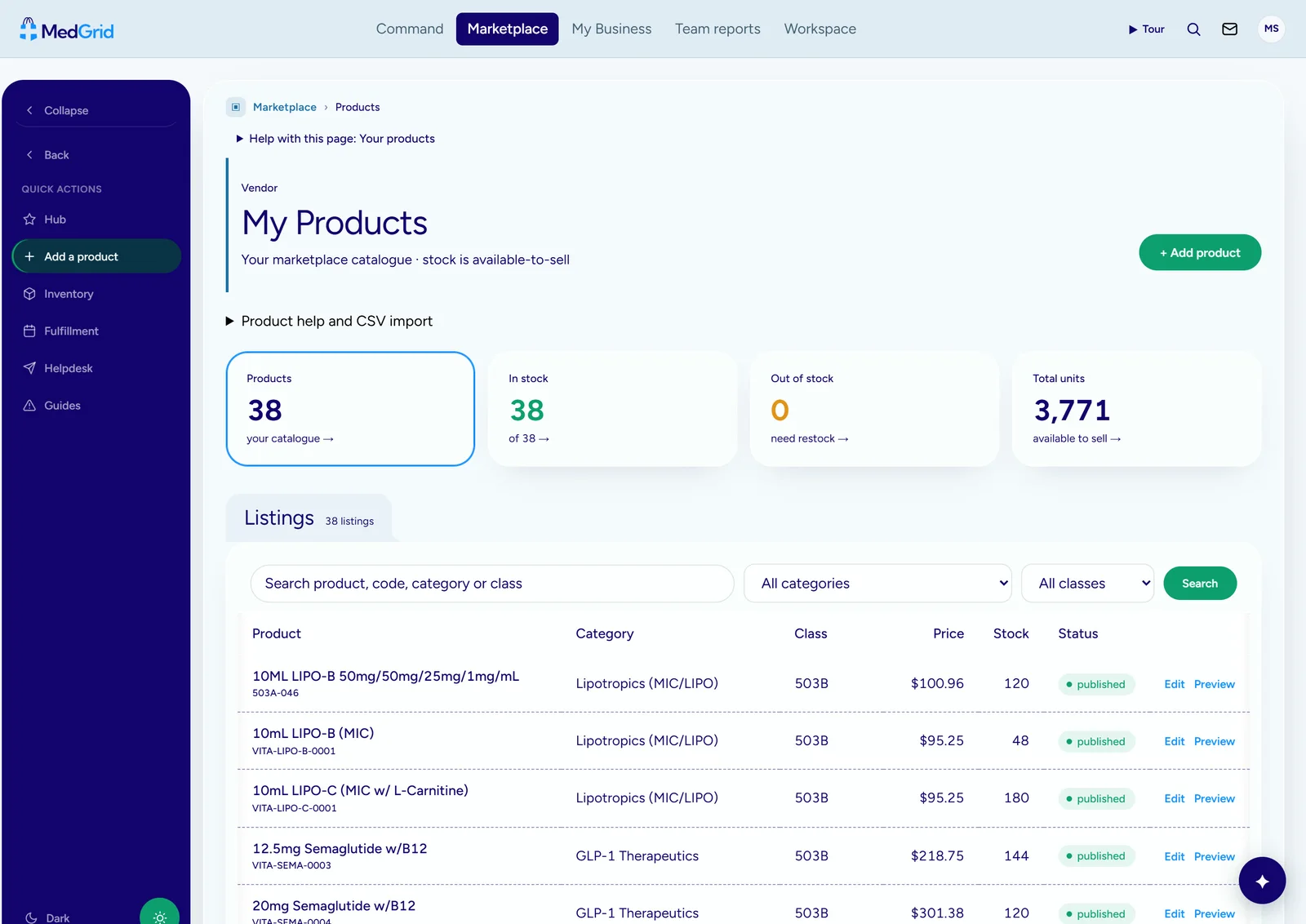
List products with full sourcing and regulatory context, and reach verified clinicians directly, without losing visibility into where products end up.
Fulfill orders through a structured storefront with vendor tooling for catalog, inventory and order management, with every counterparty credential-checked.
Order from vendors that have cleared onboarding diligence, in a catalog filtered to what your credentials and jurisdiction actually permit.

In most states, only a licensed physician may own a business that delivers medical treatment. That single rule — the corporate practice of medicine — is why an MSO exists. The clinical entity stays with the physician; everything that is not the practice of medicine sits with the MSO under a management services agreement.
So an MSO in aesthetics and wellness is not a consultant and not a franchise. It is the operating company behind the clinic: it forms the entities, papers the relationships, employs and pays the non-clinical staff, buys the supplies, runs the systems, and keeps the compliance file current — while clinical judgment stays entirely with the physician and the providers they direct.
Done properly, you should not be able to tell where the paperwork ends and the clinic begins.
Most clinics arrive at MedGrid with some of this half-built — an LLC that should be a PC, a director on a handshake, insurance bound to the wrong entity, protocols copied from a course. We rebuild the structure underneath a working business without shutting it down, and take nothing in equity for doing it.
CPOM is the rule. An MSO is the structure built to comply with it. One is imposed on you; the other is how you legally operate a clinic anyway.
A doctrine in state law, not a company or a service. It holds that medical judgment belongs to licensed clinicians, so a non-physician or a general corporation may not own or control an entity that practices medicine.
A company that provides everything a clinic needs that is not the practice of medicine, under a written management services agreement with the professional entity.
The two meet in the friendly-PC model: a physician-owned professional entity delivers the care, an MSO owned by you provides everything else under a management services agreement, and the line between them is drawn — in writing — where your state says it must be.
The corporate structure your state requires, filed correctly the first time rather than corrected under pressure later.
The contracts that make a friendly-PC arrangement hold up when a regulator, an insurer or a buyer looks at it.
Coverage bound to the right entity, for the right scope, before the first patient is seen.
Staff hired, classified and paid on infrastructure that survives an audit.
The documents your team runs on every day, written for your state and your service menu.
The platforms and accounts that turn a licensed clinic into a working one.
To be precise about ownership: in a CPOM state the professional entity must be owned by a licensed physician — that is the law, not our preference, and no MSO can change it. What we can say plainly is this: MedGrid takes no equity in your business, holds no purchase option, and does not direct clinical care. Your brand, your patients, your economics and your decisions about how the clinic runs stay yours; the professional entity is owned and controlled by a physician because your state requires it.
These aren't poster values. They decide what gets built, which vendors get listed, and what we say no to.
Both sides of every transaction are verified. Clinicians prove their credentials; vendors go through onboarding diligence before a single product lists.
Who the vendor is, what the product is, and what it costs — stated plainly on the listing. If we can't present a product honestly, it doesn't go in the catalog.
Regulation is a design input, not an afterthought. Federal and state rules differ, and state law is often stricter — the platform is built to respect both layers, not paper over them.
Built around how independent practices actually buy. Solo physicians use MedGrid free; the platform earns its keep from teams and vendors, not from gating clinicians.
Medical commerce is regulated by several authorities at once, and the rules genuinely differ by product, credential, and state. Here is how MedGrid handles that — without pretending it's simpler than it is.
Every clinician account is verified before it can transact. We confirm who you are and what you're licensed to do — and the marketplace behaves accordingly.
No DEA registration? You can still join — your catalog simply won't include categories that require one.
The catalog isn't one-size-fits-all. Product categories unlock based on the credentials you've verified and the jurisdiction you practice in.
Gating happens at the platform level, so neither side has to rely on the other's paperwork.
US federal law and individual state rules regulate medical purchasing differently. They overlap, they conflict, and state law is often stricter than federal. MedGrid never assumes one uniform regime — the platform surfaces what applies to your location and your credentials. We operate in the United States only.
The nationwide baseline: HIPAA, the Food, Drug & Cosmetic Act, the Controlled Substances Act, FDA device and compounding rules. Necessary — but never sufficient on its own.
Fifty different sets of medical board, pharmacy board, and telehealth rules, plus state controlled-substance schedules and privacy laws. What's routine in one state can be prohibited in the next.
What this means in practice: MedGrid surfaces the federal and state rules that apply to a clinician's verified location and credentials, and gates the catalog accordingly. It does not — and cannot — replace a clinician's own obligation to practice within their license, or a vendor's obligation to sell within theirs. We'd rather state that plainly than imply the platform makes regulation disappear.
Every relationship on the platform runs on a written agreement. This is the short version.
MedGrid is operated by MedGrid, LLC, a Delaware limited liability company headquartered in Miami, Florida. It runs the platform and its payment processing, and decides which products may list.
Terms of UseThe Terms of Use are governed by Delaware law. A dispute goes first to negotiation and mediation, then to binding JAMS arbitration seated in Miami Beach, Florida.
Terms of UseManufacturers and distributors sell through MedGrid as independent companies, not MedGrid's agents, partners or employees. Each signs a marketplace agreement and stays responsible for its own products, recalls and adverse-event reporting.
Vendor AgreementMedGrid is a technology and payment-facilitation platform. Products are supplied by pharmacies and third-party vendors, and the dispensing pharmacy or vendor is the seller of record.
Return & Refund PolicyBuyers pay through MedGrid's payment processing. MedGrid pays each vendor its proceeds monthly, less a marketplace fee that also covers sales-representative commissions, so vendors are not charged separately for those.
Vendor AgreementPhysicians and clinics buy as independent licensed providers, not as MedGrid's employees or agents, and keep sole authority over every clinical decision. MedGrid does not practice medicine or give medical advice.
Physician & Clinic AgreementsPatient-specific prescriptions are compounded and dispensed by licensed pharmacies, which hold the state licenses and permits for everywhere they ship and answer for their own compounding.
Pharmacy AgreementMedGrid's field representatives are independent contractors, not employees. They are paid by MedGrid, and no commission is paid on product paid for by a federal health care program.
Representative AgreementA summary for orientation. The agreements themselves govern. Read theTerms of Use andReturn & Refund Policy; vendor, clinician, pharmacy and representative agreements are provided and signed during onboarding. Questions about how MedGrid is structured?Contact us.
Support tickets, phone and email are handled by a team that knows the catalog, the vendors and the rules behind them.